Drawing from the Story of Agni—the Fire God—and the Khandava Forest in the Mahabharata
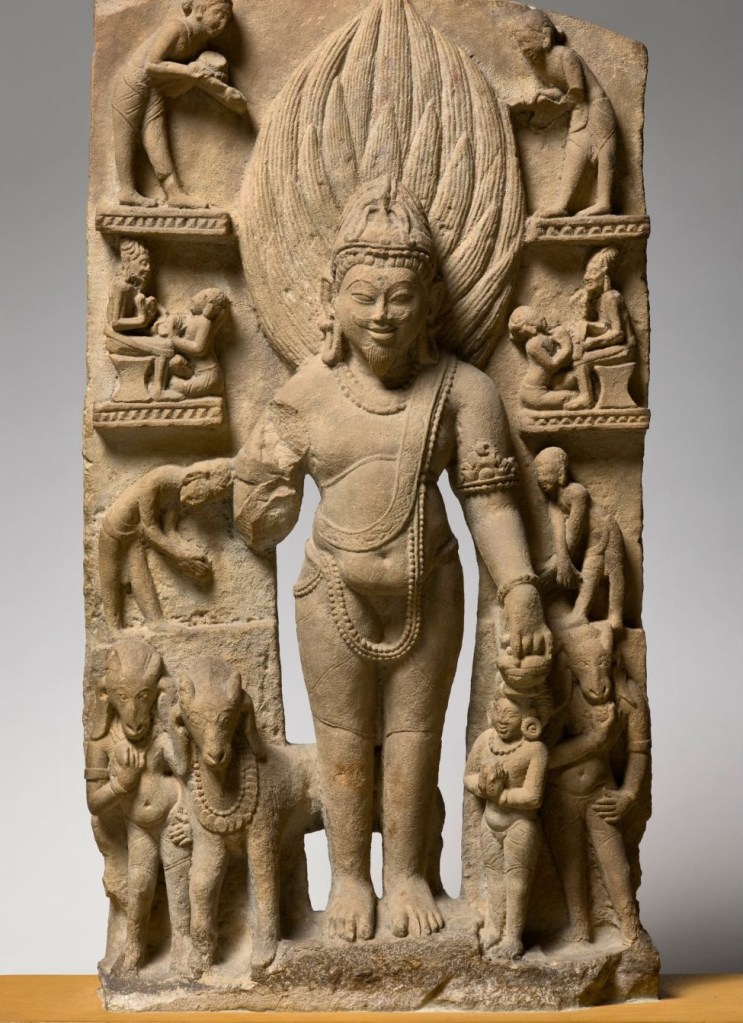
sculpture : Agni, God of Fire| The Cleveland Museum of Art, Cleveland, OH
During the past weeks, I could say that I have been enjoying teaching and practicing Yoga Asana more than I ever have… I have been more active and invested in my work, happy to teach the few students that find their way to me in remote Limeni, and also more playful in my own practice. What initially appeared as “a deliberate effort to be in action” has gradually become natural, and has proved to be deeply nourishing to my energy.
During the past months, I have gone through long periods of low and heavy energy, which have sometimes affected my mind. While in that space, I often recall an episode from the epic of the Mahabharata called the Khandava-daha Parva (“The Burning of the Khandava Forest”), which I am happy to share here.
The story goes that a king performed a great fire sacrifice for many years, pouring enormous quantities of clarified butter (ghee) into the sacred fire. Agni, the fire god, had to consume all of it to the point of indigestion; his tejas was weakened, leaving him unable to perform his cosmic function properly.
The Sanskrit word tejas is usually translated as “brightness,” but it encompasses many other aspects, referring to vitality, radiance, power, and energy.
Seeking a way to restore his fiery power, Agni asked for the help of Brahma, the creator god. Brahma told him that the only way would be to consume the living beings and vegetation of the dense and luxuriant Khandava Forest. However, the forest was under the protection of Indra, the king of the gods.
After a series of events involving the intervention of Arjuna, the prince and great warrior of the Mahabharata and the Bhagavad Gita, and his cousin Krishna, the avatar of Vishnu, the preserver god (and also Arjuna’s charioteer in the Bhagavad Gita), as well as many other characters, Agni is finally able to burn the forest, and in doing so restore his vigor and divine power.
Agni represents our inner digestive and transformative force. An allegorical reading of this episode suggests that excess—even of something pure like sacrificial ghee—can weaken rather than strengthen us. The story also suggests that restoration and renewal arise only when we act fully. When Agni burns the forest, he becomes active, whereas when he consumes ghee, in this state of overload he becomes passive, merely receiving what is offered to him. Passivity and stagnation drain energy; action, when aligned, can restore and strengthen it.
Of course, we may question the morality of destroying a forest and all the life it contains. Yet this destruction can also be understood as integration, as transformation: nothing is truly lost; it simply changes form.
Transformation requires the full activation of energy against stagnation. Effort and discipline are the gateway to regaining energy, and this is something I have been really rediscovering through my practice and, more generally, through work 🙏

