Exploring decision-making, action, and discernment through literature and yoga
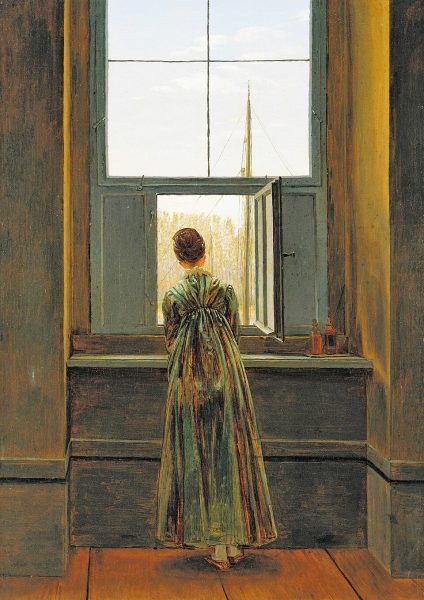
Painting : Frau am Fenster, Caspar David Friedrich, 1822 (Public domain)
Chocolate cake or apple pie? Travel by train or by plane? Pay the heating bill or the rent first? Speak your mind or choose your words carefully? Who should you listen to—your heart, your gut, or your brain?
Our lives seem to consist of an endless series of choices—more or less easy, more or less rational, always subjective, and rarely entirely satisfying. To choose is also to renounce the countless other possibilities. Sometimes, it may seem easier—and perhaps more rational—not to choose at all than to make a choice while being fully aware of its limitations and its possible consequences.
Our ability to choose shapes our capacity to act. I believe I can say, with only limited objectivity, that I am capable of making thoughtful choices and decisions before acting. Yet I know that I sometimes act instinctively… perhaps even impulsively. I also have to admit, not without a certain amount of embarrassment, that when I find myself at a complete impasse, unable to decide, I sometimes leave it entirely to chance, settling the matter not by rolling dice, but by tossing a coin.
Decision-making is, in fact, remarkably difficult !
This subject has long fascinated neuroscientists, psychologists, cognitive scientists, and researchers in many other fields. Whenever I reflect on it, two very different literary figures come to mind: Bartleby, from Herman Melville’s Bartleby, the Scrivener, and the Underground Man from Fyodor Dostoïevski’s Notes from Underground.
In Bartleby, the Scrivener, Herman Melville tells the story of a copyist working in a Wall Street law office who gradually begins to answer every request with the same phrase:
« I would prefer not to. »
Without ever expressing an outright refusal, this simple formula suspends decision and, with it, action. By adopting this stance, Bartleby creates a growing sense of unease and profoundly unsettles his employer. To the lawyer, Bartleby becomes an enigma. He can neither understand his motives nor figure out how to respond to a man who neither openly resists nor truly consents.
Little by little, this suspension of decision seems to affect the lawyer himself. One could say that Bartleby inhabits a space in which both the will and the impulse to decide have been neutralized. Yet, by refusing to choose between acceptance and refusal, between submission and rebellion, Bartleby paradoxically succeeds in undermining the logic of obedience and, more specifically, the unspoken rules that govern the workplace. His passivity becomes quietly subversive.
One of the most fascinating aspects of the story is that Melville never explains Bartleby’s behaviour.
Dostoïevski approaches the neutralization of will and decision from a very different perspective. In Notes from Underground, the narrator embodies this struggle in a deeply painful way. Having withdrawn from society, the Underground Man is trapped within his own consciousness. He is torn between reason and desire, freedom and paralysis, thought and action. He famously declares,
« An excessively lucid consciousness is a disease. »
The Underground Man understands too much: every motive, every consequence, every justification, every objection. Every decision immediately becomes open to doubt. He writes:
« A man of action is, by nature, a limited man. »
The Underground Man is restless; his consciousness is saturated and his reflective mind has become hypertrophied, to the point of paralysis.
What often makes decision and action so difficult is not a lack of information, but an excess of it—an excess that breeds confusion. It is an idea that Patanjali introduces at the very beginning of the Yoga Sūtras.
Yoga Sūtra I.2
Yogaś citta-vṛtti-nirodhaḥ
« Yoga is the restraint of mental modifications. »
Patañjali goes on to define these mental fluctuations more precisely in Yoga Sūtra I.6:
pramāṇa viparyaya vikalpa nidrā smṛtayaḥ
« Real Cognition, Unreal Cognition, Imagination, Deep Sleep and Memory »
Patañjali distinguishes consciousness itself from the contents of consciousness. For him, the problem is not the mind as such, but a mind that constantly generates alternatives, scenarios, projections, expectations—an endless stream of mental activity that obscures the clarity of awareness. The yoga he proposes does not seek to eliminate thought, but to quiet the mental noise so that the mind can recover its capacity to perceive with discernment.
In the yogic tradition, this capacity for discernment is known as viveka. Patañjali refers to it in Yoga Sūtra II.26:
viveka-khyātir aviplavā hānopāyaḥ
« The means of the removal is discriminative knowledge undisturbed. »
The Sanskrit term viveka carries the sense of distinguishing, separating, and discerning. Patañjali explains that suffering arises from confusing what is constantly changing with what is not—from identifying consciousness with the ever-changing contents of the mind. Discernment gradually reveals this distinction, creating the inner conditions from which clearer choices and wiser action can emerge.
Indecision is not necessarily a failure of will; it can also be the symptom of a consciousness that can no longer move from understanding to commitment. In Bartleby, that consciousness withdraws into silence; in the Underground Man, it consumes itself through relentless overthinking; for Patañjali, it regains its capacity to act when it ceases to identify with the ceaseless flow of its own thoughts.
Perhaps this is one of yoga’s most profound propositions. Rather than focusing solely on morality, yoga invites us to train the mind through practice, cultivating the discernment from which meaningful action can naturally arise.
 Ashtanga Vinyasa Yoga and Massage treatments with Amina Mokrane