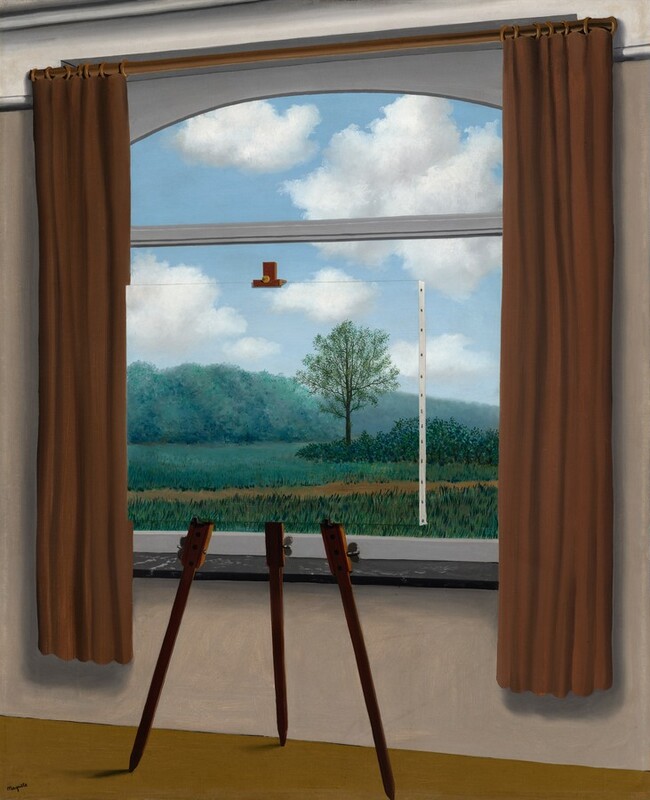
Painting : The Human Condition, René Magritte, 1935
We are often less afraid of making mistakes than we are of uncertainty itself. So we search for definitive answers, coherent systems, stable truths: a “correct” way to act or live, a solution to every problem, a logic behind every event…
But what drives this restless need to know? And how can we respond to it without locking ourselves into certainties that freeze reality—turning an interpretation, a perspective, a way of seeing into something sacred and unquestionable? How do we avoid slipping into the trap of “rightness,” and the quiet sense of moral superiority that can come with it?
For Friedrich Nietzsche, our relationship to the world is primarily utilitarian, and our need for knowledge is driven by two main forces.
The first is fear: fear of the unknown, of danger, of what tomorrow might bring.
The second is the will to mastery. Through knowledge, we try to appropriate the world in order to make it livable.
Behind this pursuit of knowledge lies a question of survival—not only physical, but also psychological, since human beings are deeply anxious about their fate and what they are becoming. In many ways, our choices are shaped by this need for stability and reassurance.
In The Birth of Tragedy, Nietzsche recounts a well-known Greek myth in which King Midas captures the satyr Silenus and asks him what is best for human beings. Silenus finally answers:
“The best of all things is beyond your reach: not to have been born, not to be, to be nothing. But the second best for you is—to die soon.”
For Nietzsche, this answer reveals something essential about the Greek understanding of existence—an outlook at once terrifying and lucid. Faced with the weight of life, they did not simply turn away from it; they transformed it, creating gods, tragedy, art, and beauty in order to make existence bearable. If the Greeks had to create illusions in order to endure existence, then every certainty appears as a human construction rather than an absolute truth.
Within this perspective, religion becomes the very example of a “truth” designed to soothe fear and provide answers. But what Nietzsche criticizes in religion is also extended to science and philosophy, which likewise rest on their own interpretative assumptions.
For him, there is no ultimate truth; all knowledge is perspectival and interpretative.
In paragraph 347 of The Gay Science, titled “The Believers and Their Need for Belief”, Nietzsche suggests :
“That impetuous desire for certainty which today still pours itself out among the masses in a scientific-positivistic disguise, that craving to have something firm at any price… is also a craving for support, for backing—in short, that instinct of weakness which, if it does not create religions, metaphysics, and principles of every kind, at least preserves them.”
Here, belief and the need for certainty are presented as a matter of psychological strength or weakness—not a search for truth, but a need for reassurance in a changing, contradictory, and unpredictable world.
Further on in the same passage, Nietzsche describes fanaticism as a contraction of consciousness that reduces the complexity of reality to a single truth, a single dominant perspective.
“For fanaticism is the only ‘force of will’ by which even the weak and uncertain can be brought under control, a kind of hypnotising of the whole sensory and intellectual system in favour of the hypertrophy of a single feeling, of a single dominant point of view—what the Christian calls his faith.”
Fanaticism often appears to respond to a psychological need: the need to escape uncertainty and the vertigo of reality.
In Ecce Homo, Nietzsche famously warns against the danger that certainty poses to the spirit:
“It is not doubt, but certainty, that drives one mad. But in order to feel this, one must be profound, one must be an abyss, a philosopher… We all fear the truth.”
The “free spirit” is, for him, the one capable of living without certainties and cultivating a form of scepticism that is not resignation, but a courageous and joyful stance.
At the end of paragraph 347 of The Gay Science, he writes:
“One should imagine a joy and a force of sovereignty in which the spirit has ceased to believe, ceased to desire certainty, and is trained to stand upon slender ropes and possibilities, and even to dance on the edge of abysses.”
True strength, then, does not lie in possessing definitive certainty, but in the ability to live without it.
The “free spirit” is not one who rejects truth, but one who refuses to imprison it—who accepts that understanding is always in motion, always partial, always alive.
May we learn to remain open where it would be easier to close, to think without rushing toward final answers, to resist the comfort of fixed truths. And may we, in this sense, become a little more free: capable of standing within the instability of the real without turning it into dogma.

