
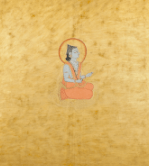
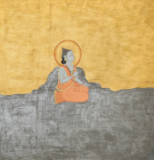
Painting : Three Aspects of the Absolute, folio 1 from the Nath Charit. By Bulaki. India, Rajasthan,
Jodhpur, 1823 (Samvat 1880). Mehrangarh Museum Trust
“Letting go” can be truly challenging, and like many other life challenges, we do not all approach it on equal footing. Sometimes, we might even think that we have finally learned to let go — until a situation arises that reveals how much work still lies ahead.
In Yoga, we have many tools to help us in this process : asana (postures), pranayama (breath work), meditation, and chanting (mind-focus work). These practices help focus the mind by redirecting it away from what it tends to cling to. Yet, while they clarify the mind and reveal the mechanisms at play, do they truly allow us to overcome them? At some point, isn’t it necessary to reengage the field of intellectual reasoning?
One thing is certain: “letting go” is not avoidance, not indifference, and certainly not about giving up. From where I stand today, I see it as an intellectual effort — a long, slow, complex, and sometimes even painful process. It begins with turning inward. An introspective dive beyond thoughts, ideas, expectations, and desires. And it calls on us to untangle within ourselves what stems from attachment, fear, imagination, preconceived notions, or ideology.
Our practices teach us how to “observe”: to observe ourselves inwardly, in relation to our own history and to the external world — to discern between what we take to be true and what is, in fact, reality, and to recognize what belongs to us and what does not. This process can lead us into the depths of our being, making us appear austere, create distance, and even isolating us.. Yet without this inward journey, the path to genuine letting go remains incomplete. Might the greatest risk lie here: that in trying too hard to let go, we deepen our attachment to the very thoughts we long to release, only to find ourselves more tightly confined within our own minds?
Perhaps this is why, although the inward movement is essential, true “letting go” also requires that we reach outward.— a reminder that, most of the time, we are viewing things from our own small, personal, subjective frame of reference. Around us, the world is immense and full of diversity, with a multitude of different centers. Cultivating the connection with others through love and compassion is essential, as it offers us not only a necessary support but perhaps the only true space in which we can experiment and learn through feedback.
Letting go and finding a sense of inner grounding and lightness in life doesn’t come easily. In many ways, the path must be walked alone. Yet cultivating love, compassion, and a sense of connectedness along the way both lights the path and gives it meaning.
 Ashtanga Vinyasa Yoga and Massage treatments with Amina Mokrane