« If one could follow it to its psychological roots, one would, I believe, find that the main motive for “non-attachment” is a desire to escape from the pain of living, and above all from love, which, sexual or non-sexual, is hard work. But it is not necessary here to argue whether the other-worldly or the humanistic ideal is “higher”. The point is that they are incompatible. One must choose between God and Man, and all “radicals” and “progressives”, from the mildest Liberal to the most extreme Anarchist, have in effect chosen Man. » – George Orwell[1]
Orwell and Gandhi: Non-Attachment and Its Limits
The citation above is taken from Reflections on Gandhi, an essay written by George Orwell, the author of 1984 and Animal Farm, in 1949, one year after Gandhi’s assassination, during a tense period in history following the Second World War, characterised by the beginnings of the Cold War and the rise of anti-colonial movements.
This essay responds to the first publication of Mahatma Gandhi’s autobiography, The Story of My Experiments with Truth, in 1949. Orwell adopts a critical stance on Gandhi without questioning his integrity, moral worth, or historical importance. He mainly questions the effectiveness of non-violence when faced with totalitarian regimes or in contexts of war and brutal power struggles. He also criticises renunciation and the pursuit of “non-attachment,” seeing them as extreme, scarcely achievable practices that sometimes clash with the most basic human instincts and needs.
Confronted with this text, I feel conflicted, both agreeing and disagreeing with Orwell’s arguments, and find it hard to take a definitive stance.
Yoga and Engagement with the World
In today’s world, what attracts individuals to the path of yoga and non-attachment? Is there, perhaps, a desire to escape a world viewed as deceiving, disappointing, or painful? Can the pursuit of personal spiritual realisation and awakening be harmonised with social engagement—or, rather, social action? To what extent do yogis remain grounded in their humanity and genuinely connected to “the other”?
These are questions I find difficult to answer in a way that withstands both theory and lived experience. On a theoretical level, I can grasp that a yogi seeks to disidentify from their desires, possessions, social status, and conditioning. Through this decentering, the boundaries of the Self soften, allowing it to expand toward a universal consciousness, in which the individual perceives themselves as an integral part of a larger whole, connecting human beings, animals, nature, and even the planets, stars, and everything that manifests.
Built on this expanded concept of Self, the yogi develops a relational view of the world, where everything is interconnected. Far from leading to withdrawal from the world, this awareness should enable the yogi to engage more justly and consciously, with an attitude filled with compassion and respect for all beings and everything.
Alas, I often struggle to translate my theoretical understanding into lived experience. Observing the trajectories and practices of many—if not most—of the yogis I’ve encountered (including myself), I notice discourses (often dissonant), social and political inaction, or actions that sometimes starkly contradict yoga’s core values. This leads me to wonder if we yogis live in a bubble. We are part of the world yet somehow separated from it. I question whether, instead of decentering, we tend to over-centre; instead of including, we end up excluding; and whether, at times, we deceive ourselves.
This sometimes makes me doubt—an obstacle on the path of yoga—yet these questions are important to me and need to be addressed, even though I still cannot form a clear opinion about them. It simply wouldn’t be honest to sweep them under the rug!
Non-Violence in the Face of Political Reality
Besides his criticism of renunciation and non-attachment, Orwell questions in his essay whether it is possible to reconcile absolute morality with political action. He suggests that, to some extent, Gandhi was used by the British imperialists, who initially did not see him as a threat. He emphasises that non-violence can only be an effective strategy under certain conditions: widespread adherence by the oppressed population, and only when the opponent has moral sensibility and cares about public opinion and ethical reputation.
Violence and human cruelty horrify me. Sadly, we live in a world shaped by power and dominance, where violence becomes commonplace – present at all levels and in nearly every part of our societies. So how should one respond when confronted with violence, or when being oppressed and dominated?
I genuinely believe that the use of violence creates a vicious cycle: even if it results in a temporary period of stability through domination—whether physical, psychological, or economic—it inevitably leads to new acts of violence, which in turn cause more violence and unrest.
Violence bears a heavy toll. It is not only the cost of human or material losses, or of moral and physical injuries, but also the price of the traumas and resentments it sows like seeds (karma) in the unconscious minds of individuals—seeds that are then passed down from one generation to another, through families, communities, and nations.
I completely oppose the use of violence. However, I listen to and agree with Orwell when he discusses Gandhi’s Satyagraha (holding firmly to truth) as a way to confront the opponent:
« … he (Gandhi)believed in “arousing the world”, which is only possible if the world gets a chance to hear what you are doing. It is difficult to see how Gandhi’s methods could be applied in a country where opponents of the regime disappear in the middle of the night and are never heard of again. Without a free press and the right of assembly, it is impossible not merely to appeal to outside opinion, but to bring a mass movement into being, or even to make your intentions known to your adversary. … But let it be granted that non-violent resistance can be effective against one’s own government, or against an occupying power: even so, how does one put it into practice internationally? »
History shows us that emancipation — the acquisition of freedom, autonomy, and rights — begins with resistance, the ability to rebel and to say ‘no,’ a process almost always accompanied by various forms of violence, as demonstrated by anti-colonial, anti-fascist, anti-segregation movements, and social struggles.
The Bhagavad Gita: Action, Non-Violence, and Duty
The Bhagavad Gita (BG) was Gandhi’s most cherished and formative text. He said of it:
“When disappointment stares me in the face and all alone I see not one ray of light, I go back to the Bhagavad Gita. I find a verse here and a verse there, and I immediately begin to smile in the midst of overwhelming tragedies.”
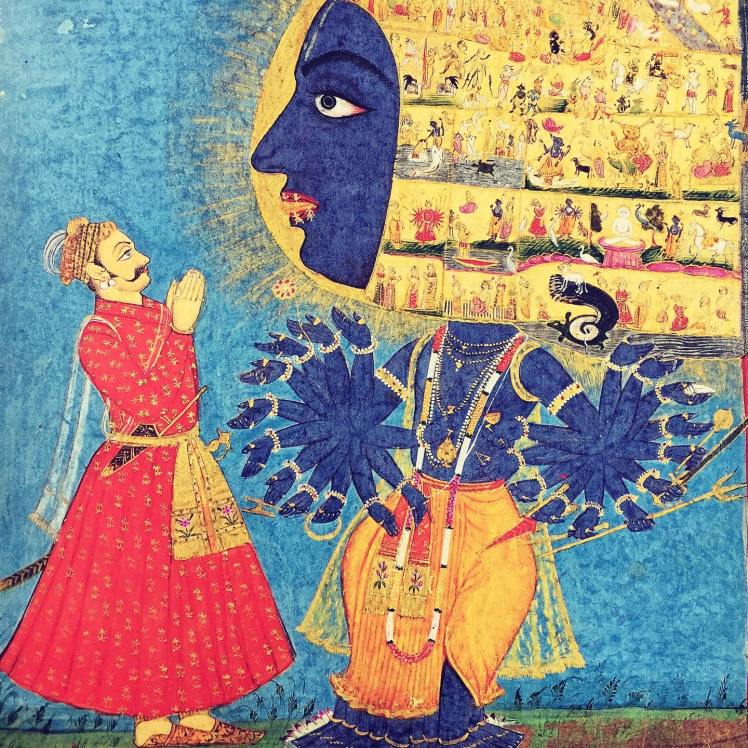
The Bhagavad Gita presents a compelling view on non-violence and non-attachment. The story is part of the great epic, the Mahabharata. It takes place on a battlefield just before a fratricidal war begins. The warrior Arjuna, leader of one of the clans, is filled with doubt and moral struggle over fighting against his own relatives. A dialogue then starts between him and his charioteer, Krishna, a divine incarnation of the god Vishnu. Krishna reveals himself as Arjuna’s Guru and teaches him about yoga, dharma (duty), bhakti (devotion), and selfless action, showing him how to act rightly without attachment, even in the midst of a battle. The Bhagavad Gita promotes non-violence as an ideal, yet permits violence in the pursuit of duty and righteous action, when carried out ethically and without attachment.This is notably illustrated in Chapter 2, Verses 31 and 32, when Krishna tells Arjuna:
svadharmam api cāvekṣya na vikampitum arhasi |
dharmyād dhi yuddhāc chreyo’nyat kṣatriyasya na vidyate|| 31 ||[2]Considering your dharma (duty as a kṣatriya, from the caste of warriors), you should not vacillate. For a warrior, nothing is higher than a war against evil.[3]
yadṛcchayā copapannaṃ svarga-dvāram apāvṛtam |
sukhinaḥ kṣatriyāḥ pārtha labhante yuddham īdṛśam || 32 ||The warrior confronted with such a war should be pleased, Arjuna, for it comes as an open gate to heaven.
And in Chapter 3, Verse 30 he says :
mayi sarvāṇi karmāṇi sannyasyādhyātma-cetasā |
nirāśīr nirmamo bhūtvā yudhyasva vigata-jvaraḥ || 30 ||Performing all actions for my sake (God), completely absorbed in the Self, and without expectations, fight! – but stay free from the fever of the ego.
The Bhagavad Gita captivates me. Not only is it beautiful and lyrical, but I also find its teachings inspiring. Yet, the text leaves much room for interpretation. It inspired Gandhi, who saw its narrative as a metaphor for the inner battle of the Self, shaping his philosophy of non-violence and moral action; however, removed from this moral and metaphorical perspective, the same text, in the hands of fascist movements or, more recently, Hindu nationalists, can become a tool of propaganda that justifies violence. Moreover, the text itself evokes a certain unease in me, stemming from the fact that the ideas it conveys support an established social order governed by a caste system—unjust and unequal—which profoundly conflicts with my own values.
It is intriguing to observe that questions about the legitimacy of violence have existed since time immemorial—questions that are difficult to answer definitively. Throughout history, humankind has struggled with defining the contexts, circumstances, and conditions in which violence might be considered acceptable. If taken literally, the Gita implies that violence can be justified in the name of righteous and selfless action; yet the issue remains: in societies ruled by power and dominance, who can determine when and how the use of violence becomes legitimate ?
 Ashtanga Vinyasa Yoga and Massage treatments with Amina Mokrane